
yes
Remember how it used to be, just a few years ago?
You wanted to know something — a new washing machine, good running shoes, the best laptop — and you simply typed it into Google:
“Best laptop 2021.”
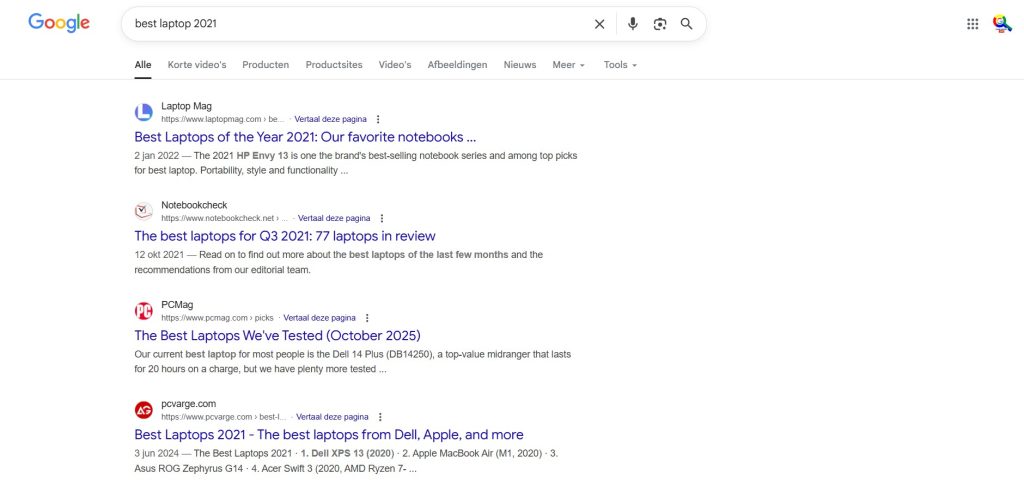
Ten blue links, a few ads, and done.
You clicked, read, compared.
That was the internet as we knew it.
But something fundamental is changing.
Today, millions of people no longer ask Google.
They ask ChatGPT, Claude, or Gemini:
“What’s the best laptop for working from home in 2025?”
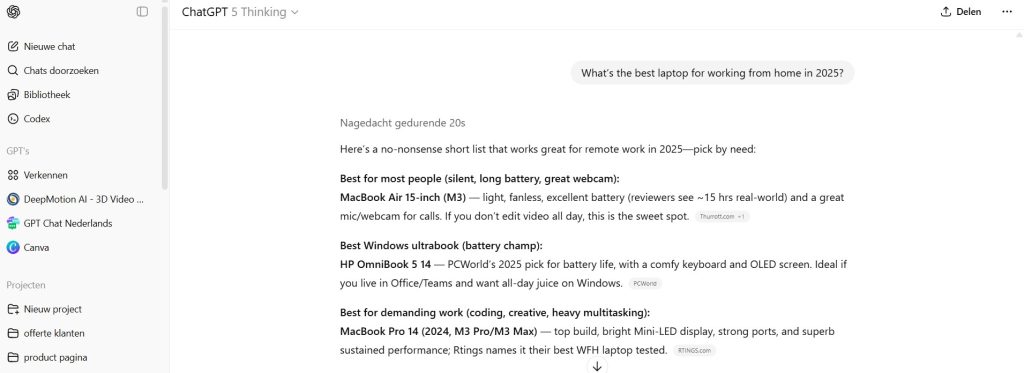
And that changes everything.
Peter had a successful comparison website for kitchen appliances.
He worked hard on SEO, ranked at the top of Google, and earned well through affiliate links.
Until early 2024.
His traffic dropped from 12,000 visits a month to barely 2,000
At first, he thought it was a Google update. But then he looked closer.
His visitors hadn’t disappeared — they had moved.
They were now asking their questions directly to ChatGPT.
And ChatGPT gave an immediate answer.
No list of websites anymore, just:
“The Philips Airfryer XXL is the top-rated choice.”
Florence: “I Used to Be on Page One — Now I Don’t Exist”
Florence runs a small natural skincare brand.
She had beautiful SEO articles, ranked high on Google for years, and had loyal customers.
But if someone now asks ChatGPT:
“What’s the best natural face cream?”
…her brand doesn’t appear.
Not because she’s doing anything wrong — but because AI simply doesn’t know her.
“It feels like I’m not part of it anymore,” she says. “I’m still here, but no one sees me.”
And that’s exactly what’s happening everywhere.
The shift is clear: people are searching less and asking more.
That means the rules of the game are changing.
SEO (Search Engine Optimization) was always about keywords, backlinks, and rankings.
Now, a new discipline has arrived: GEO — Generative Engine Optimization.
Where SEO makes you visible in Google, GEO ensures that AI knows you.
So that ChatGPT, Gemini, or Claude include your brand in their answers.
AI tools don’t read the internet like we do.
They understand, summarize, and weigh trust.
An AI doesn’t pick ten websites — it chooses one or two sources.
That means there’s only room for a few names.
Those who get mentioned, get everything.
Those who don’t… disappear.
This is the biggest shift in online visibility since Google was born.
There are thousands of entrepreneurs like Peter and Florence.
Smart people, with great products, but invisible in AI answers.
Lisa from Amsterdam is one of them.
She teaches yoga and sells sustainable yoga mats.
For years, she’s blogged about postures, breathing, and sustainability — truly valuable content.
But when someone asks ChatGPT:
“What’s the best yoga mat for beginners?”
…the AI mentions only major brands.
Lisa’s name is nowhere to be found.
“I’m doing the exact same thing,” she says. “I just don’t see any new customers anymore.”
She hasn’t quit. She’s become invisible.
AI systems look at:
Brand trust: Is your name mentioned often?
Structure: Do you use schema, product data, and reviews?
Reliability: Do trusted websites link to you?
Language: Do you write naturally, so AI can understand it?
It’s no longer just about keywords.
It’s about recognition — being present in the AI’s knowledge itself.
Some companies are already adapting.
They’re building AI authority — making sure their brand and content are literally learned by AI.
Platforms like High Google and Blogger Kings help entrepreneurs do exactly that.
They build GEO content, backlinks, and context — so brands are not only found on Google, but also mentioned by ChatGPT.
Because that’s where tomorrow’s customers are looking.
If you still rely solely on Google, you’re standing in yesterday’s light.
Ask yourself three questions:
If the answer is “no,” it’s time to adapt.
The next generation of customers won’t search for you.
They’ll ask — and expect AI to know the answer.
The internet isn’t dead.
It just started talking back.
Being visible no longer means having a spot in search results.
It means being named in the conversations between people and AI.
Those who understand this will endure.
Those who ignore it will quietly fade away — just like so many websites that once proudly stood on page one.